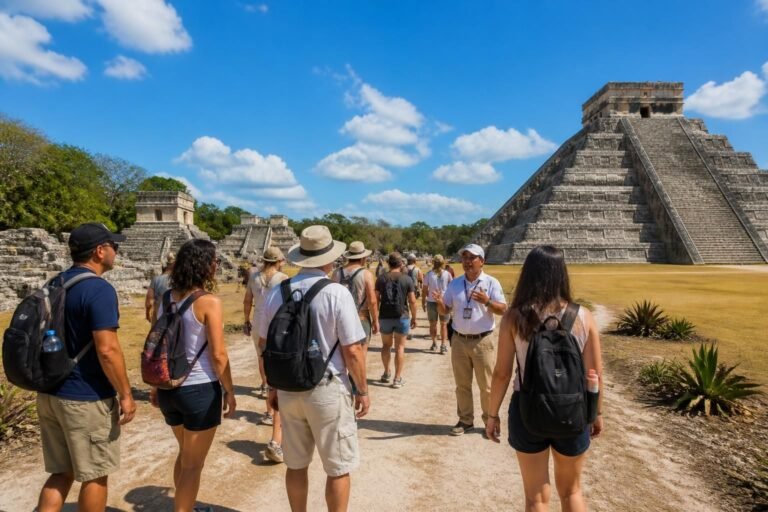
The ancient Maya site of Chichen Itza is renowned worldwide for its impressive architectural marvels that tell stories of a sophisticated civilization deeply intertwined with the cosmos. Among these, the Caracol stands out as a unique example of Mayan ingenuity in astronomical observation. Unlike the straightforward stepped pyramids and rectangular temples, the Caracol’s round shape and spiral staircase give it a distinct identity, symbolizing more than just an architectural feat but a gateway to the heavens. This observatory played a pivotal role in guiding the Maya through their religious rituals, agricultural cycles, and social organization, with the celestial bodies serving as their ultimate clock and calendar.
Located strategically within the archaeological zone, the Caracol offers visitors an opportunity to connect with Mayan culture in a deeply spiritual and scientific way. Its carefully aligned windows and openings allow an understanding of how the Maya read the skies, especially tracking the movements of Venus and the sun, critical to their calendar system. The observatory’s ancient functions go beyond mere stargazing—its design and purpose reveal a sophisticated knowledge of celestial mechanics that influenced the prosperity and governance of the ancient civilization. This article explores the mysteries of the Caracol, uncovering the secrets of its astronomical purpose, architectural uniqueness, and continued significance in archaeological studies.
Key Highlights:
- The Caracol is an ancient Mayan observatory at Chichen Itza, characterized by its round tower and spiral staircase, offering insight into Mayan astronomy.
- Strategically located in the southern section of Chichen Itza, its openings align with the movements of the sun, stars, and especially the planet Venus.
- The observatory’s design uniquely combines functional astronomy with artistic elements symbolizing Mayan cosmology, including serpent motifs and representations of rain gods.
- El Caracol’s observations influenced agricultural planning, religious ceremonies, and political power within the Mayan civilization.
- Today, it remains a vital archaeological site, attracting tourists and researchers eager to delve into the intricate relationship between ancient architecture and astronomy.
The Unique Architectural Features of El Caracol Observatory in Chichen Itza
El Caracol, translated as “the snail” in Spanish, owes its name to the spiral staircase that coils inside its cylindrical tower. This distinctive architectural design sets it apart from the predominantly squared structures common in Mayan sites, emphasizing the Maya’s intent to meld form with function in pursuit of astronomical study. Rising approximately 23 meters (75 feet) atop two broad rectangular platforms, the observatory’s circular base encompasses detailed craftsmanship aligned with celestial events.
The outer walls are punctuated with narrow windows and openings meticulously positioned according to the rising and setting points of the sun, moon, and planets, particularly Venus. These alignments demonstrate an advanced understanding of celestial cycles that goes far beyond casual observation. For instance, the windows enable precise tracking of solstices and equinoxes, moments critically linked to agricultural timing and ceremonial occasions.
The entrance of the structure is flanked by balustrades carved with intertwined serpent heads, symbolizing the spiritual significance of serpents in Mayan culture—often associated with fertility, rain, and the movement of the heavens. Above the doorways, a decorative frieze features Chaac, the Mayan rain god, framed by feathers and serpent motifs, visually underscoring the connection between astronomical observations and the vital rains needed for crops.
Internally, two concentric walls create spiral chambers, guiding observers through a gradual ascent to the observation level where the priests and astronomers of the ancient civilization stood. Unlike the pyramids built primarily as religious temples or ceremonial centers, the Caracol’s rounded form was a practical solution to enhance observational perspectives through its window alignments. Its elevation on stacked platforms also made it a prominent landmark visible throughout the flat Yucatan landscape, fulfilling both ritualistic and scientific roles.
Visitors today can appreciate the mixing of aesthetics and utility, as the design stands as a testament to the Mayan mastery of architectural engineering tailored to a celestial function, something thoroughly explored in the detailed guides available at Chichen Itza Observatory astronomical significance. This integrated approach to both art and science defines the uniqueness of the Caracol and invites ongoing studies into its precise construction and cosmic alignments.

Exploring the Ancient Functions of the Caracol and Its Role in Mayan Astronomy
The Caracol’s primary function as an astronomical observatory reflects the Maya’s advanced expertise in reading the sky. By the time this structure was built around 906 AD, the Maya had developed intricate knowledge about celestial bodies, including the sun, moon, and planets like Venus, which played a critical role in their calendar and mythology.
Unlike many civilizations that depended on natural markers such as mountains, the flat terrain of the Yucatan Peninsula offered little topographical reference for astronomical tracking. The Maya ingeniously designed the Caracol’s windows to align precisely with significant points on the horizon such as the sunrise and sunset on solstices and equinoxes, as well as the heliacal risings of Venus. These solar and planetary cycles were essential for dictating agricultural periods, especially planting and harvesting, which underpinned the community’s survival.
Venus was especially important to the Maya, symbolizing war and fertility cycles. They noticed its synodic period of approximately 584 days and connected its visibility to events that shaped their military campaigns and ceremonial calendar. Observations from the deciduous environment around Chichen Itza required meticulous sky watching, and the Caracol was built to function as the ultimate tool for this purpose. Through these alignments, Maya priests could announce significant celestial occurrences in advance, a key factor granting political and religious authorities tremendous influence over the population.
The importance of this observatory transcended mere astronomy. It played a central role in Mayan cosmology, linking earthly events to divine schedules. The timing of sacred rites and festivals coincided with the cycles observed from the Caracol, ensuring harmony between the heavens and societal functions.
Experience-driven tours that emphasize this astronomical heritage, such as those provided at Chichen Itza audio guide immersive experience, reveal how the Maya synchronized their agricultural and religious life through observations made at this extraordinary monument. The observatory is much more than an architectural curiosity—it was the operational heart of celestial knowledge that empowered a vast and complex society.
How the Caracol Influenced Maya Society Through Celestial Observation and Rituals
The interplay between astronomy and daily life in the Maya culture was extensive, and the Caracol was a vital instrument that facilitated this relationship. The precise alignment of the observatory’s windows and openings allowed the prediction of key seasonal events, which dictated agricultural cycles and social customs.
Agriculture was fundamental to Mayan civilization, and the ability to forecast wet and dry seasons was essential. The Caracol provided timely information about solstices and equinoxes to direct planting and harvesting schedules. This assured food security and shaped the rhythms of communal work and celebration. Also, the rain god Chaac’s imagery at the observatory reminds us of how heavily dependent the Maya were on rainfall patterns.
Political and religious leaders, regarded as intermediaries between the gods and the people, enhanced their authority by interpreting celestial messages from the Caracol. This astronomical knowledge legitimized their rule and decisions relating to warfare or civic planning. The planet Venus, often associated with war, was tracked meticulously to time conflicts, linking astronomical events to Maya mythology and strategy.
Religious ceremonies were timed to lunar and solar events observed at the Caracol, reinforcing cultural cohesion and spiritual harmony. Rituals aligned with celestial phenomena served as public affirmations of the unity between the cosmos and Maya society.
Tourists visiting today can get a profound glimpse of this ancient connection through guided routes and expert explanations, which emphasize the scientific as well as mystical dimensions of the observatory. Curated itineraries often combine a visit to the Caracol with the main plaza and El Castillo, providing an immersive experience into the Mayan calendar’s astronomical underpinnings and the social importance of the observatory in everyday life.
The Archaeological Significance and Preservation of the Caracol Observatory
Archaeological efforts at Chichen Itza continue to shed light on the mysteries of the Caracol, as modern technology complements ancient knowledge in revealing the precision of Mayan astronomers. Techniques such as laser scanning and drone imaging have allowed researchers to examine the structure’s orientation with unparalleled detail without disturbing the site.
These studies have confirmed alignments that mark important astronomical events and underscore the sophistication of the Maya’s observational skills. Such findings elevate the Caracol’s status from a historical curiosity to an emblem of ancient ingenuity and scientific advancement.
Conservation initiatives are critical to preserving this monument against natural degradation and the impact of tourism. As interest grows in exploring this ancient civilization, responsible tourism practices enforced by local authorities ensure that visitor access does not compromise the Caracol’s integrity. Visitors should plan ahead and consult practical guides regarding access and site rules, such as those outlined in Chichen Itza ticketing and access tips to streamline their experience without adding pressure on the site.
The observatory not only captivates tourists but also inspires ongoing academic study in the field of Mesoamerican archaeology and archaeoastronomy—debates about additional interpretations and uses of the structure continue to emerge. This dynamic approach to its study reinforces the Caracol’s role as a monument that connects the past with the present and future cultural understanding.
| Aspect | Description | Significance |
|---|---|---|
| Architecture | Round tower with spiral staircase on stacked rectangular platforms | Enables precise celestial observation and reflects unique Mayan design |
| Astronomical Alignments | Windows align with solstices, equinoxes, and Venus heliacal risings | Dictated agricultural and ritual calendars |
| Cultural Role | Guided agricultural cycles, political power, and religious ceremonies | Maintained societal cohesion and celestial harmony |
| Preservation & Research | Modern technologies confirm precise alignments; ongoing studies | Highlights advanced Mayan scientific knowledge and architectural skills |
Planning Your Visit to the Caracol Observatory: Best Practices and Tips
For travelers keen on exploring the rich legacy of the Caracol within Chichen Itza, timing and preparation are essential to optimize the experience. The site is typically less crowded early in the morning, especially around sunrise when the soft light enhances the architectural details and deepens the feeling of connection with ancient astronomical phenomena.
Visitors should note that, as of now, direct access inside the Caracol is not permitted to protect the structure from damage. Observations are made from the exterior pathways, allowing panoramic views of the tower and its intricate details. Guided tours, often provided by certified local experts, add significant value by explaining the complex astronomical and cultural background, available through reputable agencies specializing in Mayan archaeology.
Combining a visit to the Caracol with nearby landmarks such as the Pyramid of Kukulkan and the Nunnery enriches the itinerary, offering a holistic perspective on Chichen Itza’s historical weave. For convenience, travelers can refer to reliable resources like independent visit guides to Chichen Itza that provide up-to-date information on tickets, site rules, and optimal routes.
- Visit early morning or late afternoon for better lighting and fewer crowds.
- Use an audio guide to deepen understanding without disrupting the site’s ambiance.
- Wear comfortable shoes and bring water, as the site involves extensive walking.
- Respect all archaeological site restrictions to help preserve this world heritage.
- Plan visits in the dry season (November to April) for the best weather conditions.
Understanding the historical and astronomical significance of the Caracol transforms a simple tour into a compelling journey through ancient time and knowledge. Travelers interested in astronomy or ancient civilizations will find this observatory to be an unforgettable highlight, offering insight into the Maya’s celestial mastery and deep cultural roots.
What is the primary purpose of the Caracol at Chichen Itza?
The Caracol was built as an astronomical observatory to study the movements of the sun, stars, and particularly the planet Venus, helping the Maya time agricultural and religious activities.
Can visitors enter the Caracol observatory?
No, access inside the Caracol is restricted to protect the structure. Visitors can view and photograph the tower from designated paths around the site.
How did the Caracol influence Mayan society?
By tracking celestial events accurately, the Caracol helped determine ritual calendars, agricultural cycles, and strategic timing for military actions, reinforcing the political and religious power of Maya leaders.
What makes the Caracol’s architecture unique among Mayan structures?
Its circular shape and spiral staircase set it apart from the typical rectangular, stepped pyramids common in Maya architecture, reflecting its purpose as an observatory with specialized celestial alignments.
How is the Caracol preserved for future generations?
Modern technology like drone surveys and laser scanning facilitates detailed research without physical impact, while visitor access is regulated to minimize damage and ensure conservation.