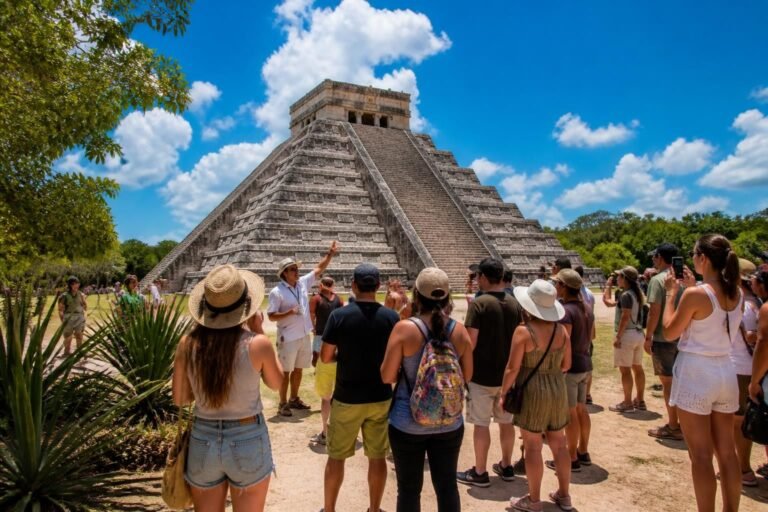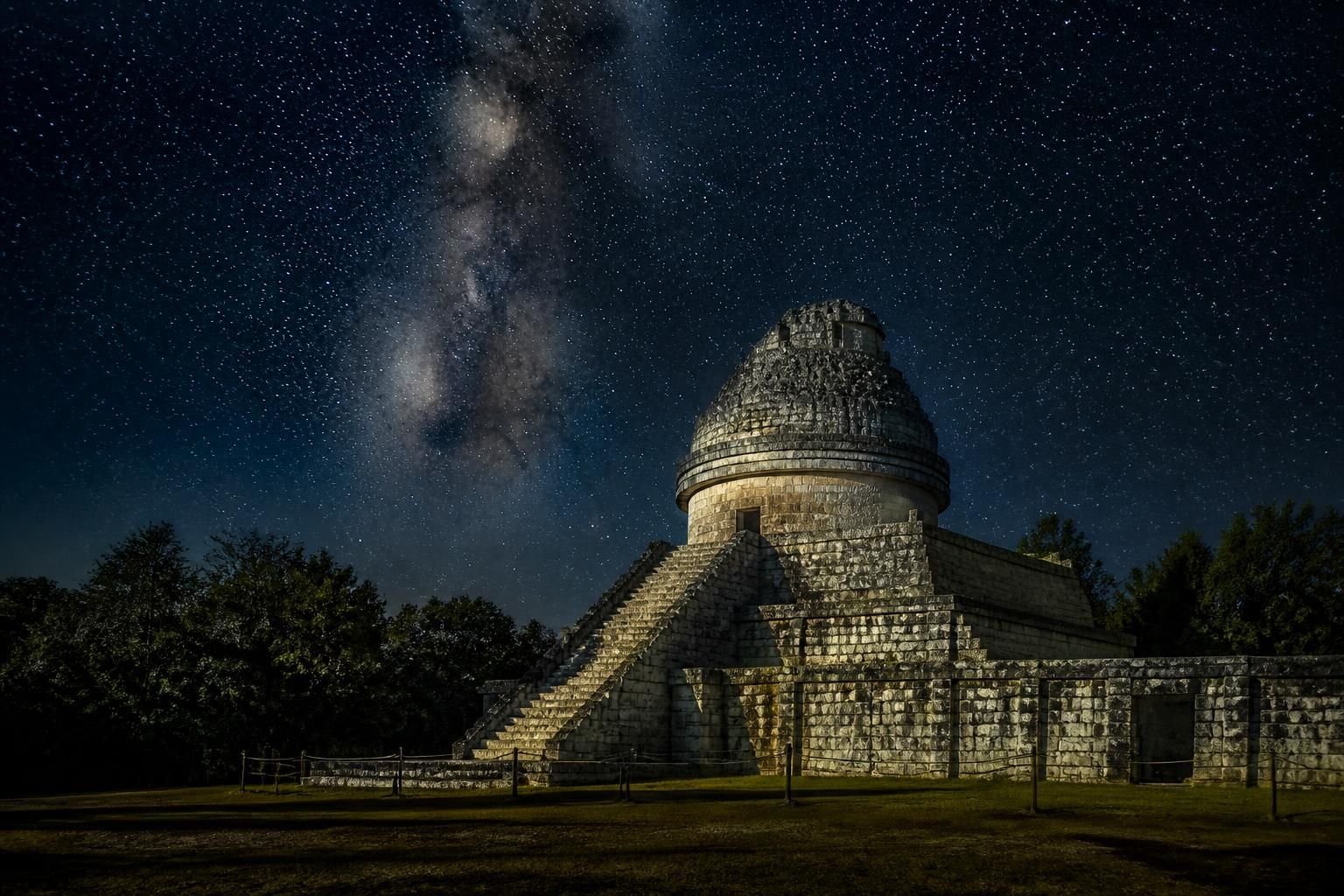

Exploring the astronomical significance of Chichen Itza’s observatory unveils a majestic fusion of ancient knowledge and architectural mastery. This pre-Columbian city, located in the heart of the Yucatán Peninsula, not only served as a political and economic hub but also as a profound celestial observatory. The intricate cosmic alignments embedded within structures like El Caracol and El Castillo reveal a civilization whose understanding of the heavens was as sophisticated as it was integral to their cultural fabric. These astronomical observations dictated ritual events, agricultural cycles, and even political power, cementing Chichen Itza’s legacy as an enduring symbol of Mayan astronomy.
Key points revealing Chichen Itza’s astronomical marvels:
- El Caracol’s unique spiral design functioned as an ancient observatory tracking Venus’s complex cycle with remarkable precision.
- El Castillo pyramid’s equinox phenomena mimics the descent of Kukulkán, blending architectural geometry with solar observation.
- Celestial alignments influenced not just religious ceremonies but the socio-political framework of the Maya civilization.
- The Great Ball Court’s acoustics embody the interplay between astronomy and ritual practice.
- The site’s integration of Toltec influences highlights a cosmopolitan exchange powered partly through shared celestial knowledge.
Architectural brilliance in Chichen Itza’s astronomical observatory design
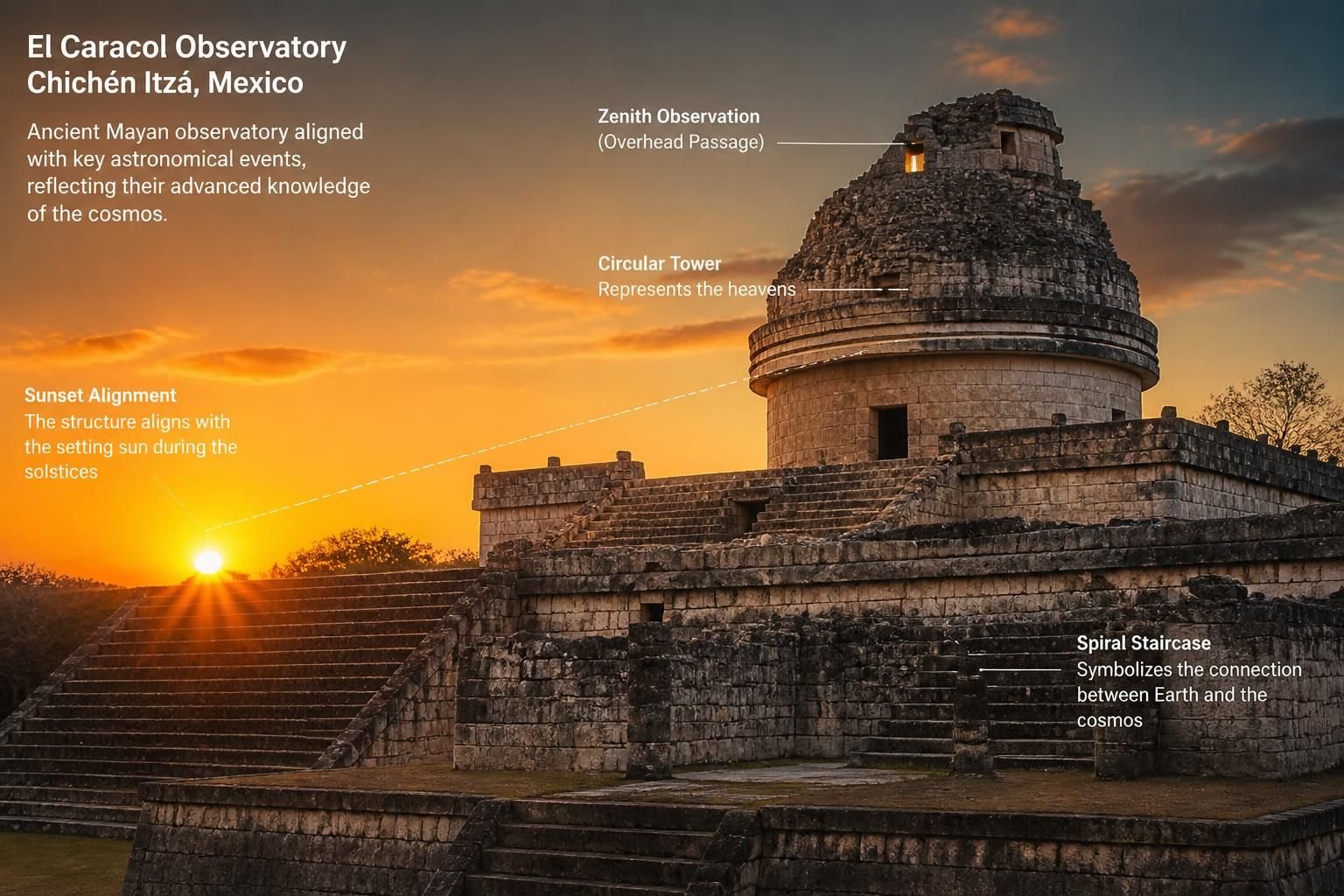
Chichen Itza’s architectural landscape is not merely a collection of imposing ruins but a carefully constructed celestial instrument. The most notable among its structures is El Caracol, locally known as “the snail,” distinguished by its circular tower atop a rectangular base and its internal spiral staircase. Unlike other Maya buildings, El Caracol’s windows are precisely aligned to observe key astronomical events, primarily the extreme positions of Venus along the horizon. This alignment underscores the Maya’s sophisticated system for tracking Venus’s 584-day synodic cycle, a feat unmatched by many ancient cultures even today.
What sets El Caracol apart as a true ancient observatory is its purposeful design: narrow shafts serve as vantage points to monitor celestial bodies with extraordinary accuracy. The observations conducted here were not abstract but held immense practical and symbolic importance. Venus, in particular, was associated with warfare and cosmic cycles; its appearances often dictated the timing of military campaigns and ritual events.
Beyond El Caracol, the design of the entire city reflects advanced knowledge of solar observations. Structures such as El Castillo demonstrate profound engagement with solar events, encoding celestial alignments in stone. For example, the pyramid’s staircases and terraces have been mathematically calibrated to reflect the solar year, with 365 steps conveniently representing the days of the calendar, intertwining astronomy with the daily lives and spiritual beliefs of the Maya people.
Recent technological advances have revealed even more about these buildings. Electrical resistivity tomography discovered massive pyramids nested within El Castillo, emphasizing that the Maya continually refined and preserved their cosmic understanding through successive architectural phases. It is this intricate blend of cosmic purpose and urban functionality that renders Chichen Itza an unparalleled example of Mayan astronomy encoded in city design.
The equinox phenomena at El Castillo and the sacred dance of Kukulkán
One of Chichen Itza’s most mesmerizing displays of cosmic mastery is the equinox phenomena that occurs twice a year at El Castillo, also known as the Temple of Kukulkán. During the spring and autumn equinoxes, the setting sun casts shadows that form a series of seven triangular shapes along the northern balustrade, creating the illusion of a massive feathered serpent slowly descending the pyramid’s staircase. This spectacle powerfully illustrates the Maya’s expert understanding of solar cycles and their ability to harness architectural geometry as a tangible representation of cosmology.
This interplay of light and shadow goes beyond aesthetics. It highlights an incredibly precise calibration of the pyramid’s dimensions and orientation, verified by archaeoastronomers to be intentional and technically sophisticated. The movement of these shadows reflects the cycle of the sun through the year and connects the terrestrial realm to the divine, embodying the myth of Kukulkán, the feathered serpent deity revered by the Maya civilization. Tens of thousands gather each equinox to witness this event, drawn by both its breathtaking beauty and profound spiritual significance.
Interestingly, the phenomenon extends beyond the two exact equinox dates. For several days leading up to and following the equinox, the serpent appears in motion, albeit less dramatically. Visitors aware of this celestial choreography might opt to experience the event during these quieter times, avoiding the massive crowds yet still witnessing the sacred cosmic dance. This highlights the dynamic relationship between ancient astronomical observation and modern tourism.
Symbolism and impact of Kukulkán’s descent
The representation of Kukulkán descending the pyramid is more than myth; it was a potent political and religious symbol. Through this celestial alignment, the Maya connected their rulers and populace with cosmic order and divine authority. The serpent was a conduit between earth and sky, reminding the people of their place in the universe and legitimizing power structures that depended on this sacred link.
El Caracol and the precise tracking of Venus: A Mayan astronomical masterpiece
El Caracol’s role extends far beyond observing the sun. It stands as a testament to how Mayan astronomy embraced planetary cycles to weave celestial events into cultural life. Venus, known as the Morning and Evening Star, had a particularly significant role. The windows in El Caracol’s tower align with the extreme rising and setting points of Venus, enabling Maya astronomers to track this planet’s movements accurately over its 584-day cycle.
This observation was critical because Venus’s appearances were loaded with meaning. Viewing Venus as an omen, the Maya scheduled warfare and ritual activities in accordance with its cycles. Carvings at Chichen Itza depict warriors associated with Venus symbolism, further demonstrating how deeply interconnected celestial observation was with political and military planning.
The precision with which the Maya calculated Venus’s cycles rivals the accuracy of later astronomical discoveries before the telescope’s invention. This celestial observatory reveals a culture that, while ancient, had a scientific approach to understanding the universe, integrating these observations into their broader societal framework in a way few other civilizations achieved.
This paradigm demonstrates that Chichen Itza was not just a city but a cosmic center where archaeoastronomy was practiced as an essential element of governance, religion, and social identity, showcasing the Maya civilization’s unmatched celestial knowledge.
The Great Ball Court and the intersection of astronomy, acoustics, and ritual
The Great Ball Court at Chichen Itza, the largest known in the ancient Americas, embodies a unique intersection of astronomical observatory function and sacred performance space. Its design goes beyond the physical dimensions—168 meters long and 70 meters wide with vertical limestone walls—incorporating acoustic properties that align with the city’s cosmic focus.
Engineering experts have demonstrated that the court acts as a massive whispering gallery, allowing a whisper at one end to be clearly heard at the opposite side over 150 meters away. This acoustic phenomenon was likely intentional, enhancing the solemnity and theatricality of the ritual ball games often tied to cosmological themes. The carvings around the ball court further depict scenes combining ritual sacrifice with mythic symbolism, including serpents of blood transforming into fertile vegetation, embodying the cycle of death and rebirth central to Maya cosmology.
This harmonization between architecture, sound, and celestial observation positions the Great Ball Court as an integral component of Chichen Itza’s astronomical observatory complex. The events held here were not mere games but embedded with gravity, reflecting cosmic cycles and renewing social and spiritual order.
| Feature | Description | Significance |
|---|---|---|
| El Caracol | Circular tower with spiral stairs and aligned windows | Accurate tracking of Venus and planetary movements |
| El Castillo | Step pyramid with architecturally encoded solar calendar | Manifestation of equinox phenomena and Kukulkán’s descent |
| Great Ball Court | Largest ancient ballcourt with unique acoustics | Combines ritual performance with cosmic symbolism |
| Sacred Cenote | Natural sinkhole used for ritual offerings | Physical connection to the underworld and cosmological axis |
Visiting Chichen Itza: Experiencing the Maya civilization’s cosmic heritage
For anyone wishing to witness the marvels of archaeoastronomy firsthand, Chichen Itza offers a deeply immersive experience. The city’s status as a UNESCO World Heritage Site and one of the New Seven Wonders of the World draws millions annually, yet careful planning allows visitors to connect with the site’s celestial wonders without the distractions of crowds.
The optimal time to visit is early morning when the complex opens or during the fall and spring equinoxes to experience the famed light serpent event along El Castillo’s staircase. However, those seeking a more tranquil encounter with the astronomical observatory should consider the days surrounding the equinox. Visiting with a licensed local guide provides invaluable context, enhancing appreciation for the astronomical, architectural, and cultural significance embedded in every stone.
Travelers arriving from Cancún or Mérida can access the site via organized tours, private drives, or frequent ADO buses. For those interested in expert-led journeys, numerous small-group tours offer in-depth exploration of the observatory, sacred cenote, and the Great Ball Court, ensuring visitors grasp the profound celestial narratives framing Chichen Itza’s grandeur.
Planning a tour around these insights is recommended; many resources such as guided tours for an unforgettable experience and best tips for a visit to Chichen Itza in 2026 provide up-to-date practical advice to enhance the journey.
Can visitors climb El Castillo at Chichen Itza?
Climbing El Castillo has been prohibited since 2006 to preserve the structure and for visitor safety. However, visitors can walk around the base and closely observe the architectural details and celestial alignments.
What makes El Caracol unique as an ancient observatory?
El Caracol’s circular design, spiral staircase, and precisely aligned window slits were ingeniously constructed to track Venus and other celestial bodies with extraordinary accuracy, reflecting advanced Mayan astronomical knowledge.
When is the best time to witness the equinox serpent phenomenon at El Castillo?
The equinox serpent occurs around March 20 and September 22, with the best experience early in the morning or during days surrounding the equinox when crowds are smaller yet the phenomenon is still visible.
How did the Maya use astronomical observations in their society?
Astronomical observations influenced agriculture, ritual events, political timing, and religion, becoming an integral part of daily life and reinforcing the cosmic legitimacy of rulers and religious leaders.
Is it possible to see Venus’s cycles from Chichen Itza today?
While modern observations are easier with telescopes, the ancient design of El Caracol provided the Maya with remarkable accuracy in tracking Venus’s synodic cycle, a practice documented in their codices and reflected in the observatory’s architecture.